A restaurant build-out is among the most demanding categories of commercial interior construction. It carries mechanical, plumbing, and ventilation requirements that exceed nearly any other commercial use, alongside health code and life-safety standards specific to food service. The complexity concentrated in the back of the house is what distinguishes a restaurant project from a standard commercial build-out, and it is where projects most often encounter cost and schedule surprises.
Dakota Contractors has delivered restaurants and hospitality venues across Metro Atlanta, including repeat engagements for multi-location operators.
Why restaurants are different from standard commercial space
A typical office or retail build-out is driven by finishes and layout. A restaurant is driven by systems. The kitchen and back of the house impose infrastructure that a general commercial space never contemplates: commercial exhaust and make-up air, grease management, extensive plumbing and gas, elevated electrical loads, and fire suppression engineered for cooking operations. These systems must be coordinated precisely, and they are subject to inspection by authorities that a standard build-out never encounters.
The front of the house carries its own demands. It establishes the brand, sets the guest experience, and frequently involves a level of finish, lighting, and millwork that rivals the most detailed office work. A restaurant build-out is effectively two projects executed in one space, and both must be delivered to standard.
The systems that drive a restaurant build-out
Kitchen exhaust and ventilation
Commercial cooking requires an exhaust hood, make-up air to replace what the hood removes, and a balanced system that maintains air quality and comfort throughout the space. This is among the most technically demanding elements of any restaurant project, and it frequently requires routing through the roof, which introduces landlord coordination and structural considerations.
Plumbing and gas
Restaurants require extensive plumbing well beyond standard commercial use: floor drains, dishwashing and prep stations, grease interceptors, and gas service sized for cooking equipment. The scope and routing of these systems are a primary cost driver and depend heavily on the condition of the existing space.
Fire suppression
Cooking operations require a dedicated fire suppression system integrated with the exhaust hood and the building's life-safety systems. This is a specialized scope subject to its own inspection and approval.
Electrical
Commercial kitchen equipment imposes electrical loads that often exceed the existing service. Refrigeration, cooking equipment, and ventilation may require a service upgrade, which depends on what the building and the landlord can provide.
Health code and accessibility
Restaurants are subject to health department review in addition to the standard building code, covering surfaces, equipment, plumbing, and sanitation. ADA accessibility, occupancy, and egress requirements apply throughout. These obligations are defined early, so they shape the design rather than disrupt it.
Existing conditions determine the budget
The condition of the space governs the cost of a restaurant build-out more than any other factor. Taking over a former restaurant, a second-generation space, can preserve significant value if the existing kitchen infrastructure, exhaust, and plumbing are sound and suited to the new concept. Converting a space that has never been a restaurant requires that every system be built from nothing, on a substantially greater scale.
Accurately assessing this at the outset is essential, and it is often where early estimates fail. Matterport 3D laser scanning captures the existing space as a precise digital model, allowing the design and the budget to be built on measured conditions rather than assumptions. For a project this systems-intensive, that accuracy is decisive.
Why scope must be defined before commitment
The complexity of a restaurant build-out is precisely why it rewards rigorous planning. A budget that underestimates the kitchen, ventilation, or code scope will expand through change orders once work is underway. Preconstruction defines the full scope, including the systems that drive cost, before the project is committed, when the design and the budget can still be aligned.
This discipline is the difference between a restaurant that opens on schedule and on budget and one that absorbs delays at every inspection. Execution then proceeds under active Construction Management, coordinating the trades, the inspections, and the schedule through to opening.
The Dakota approach to restaurant construction
Dakota delivers restaurant build-outs as commercial interior construction projects executed with the systems expertise the category demands. Existing conditions are captured precisely, the full scope is defined in preconstruction, and the project is built by a team that brings the attention of a small contractor and the resources of a large one.
Dakota has delivered restaurants and hospitality venues across Metro Atlanta since 1998, including repeat work for operators who return for their next location, among them Taste Wine Bar and Market, which engaged Dakota at multiple locations.
Selected restaurant projects in Metro Atlanta
Dakota's restaurant and hospitality work spans full-service concepts, quick-service and café formats, and entertainment-driven venues:
- Taste Wine Bar and Market — wine bar and market, repeat multi-location operator
- Your 3rd Spot — dining and entertainment venue
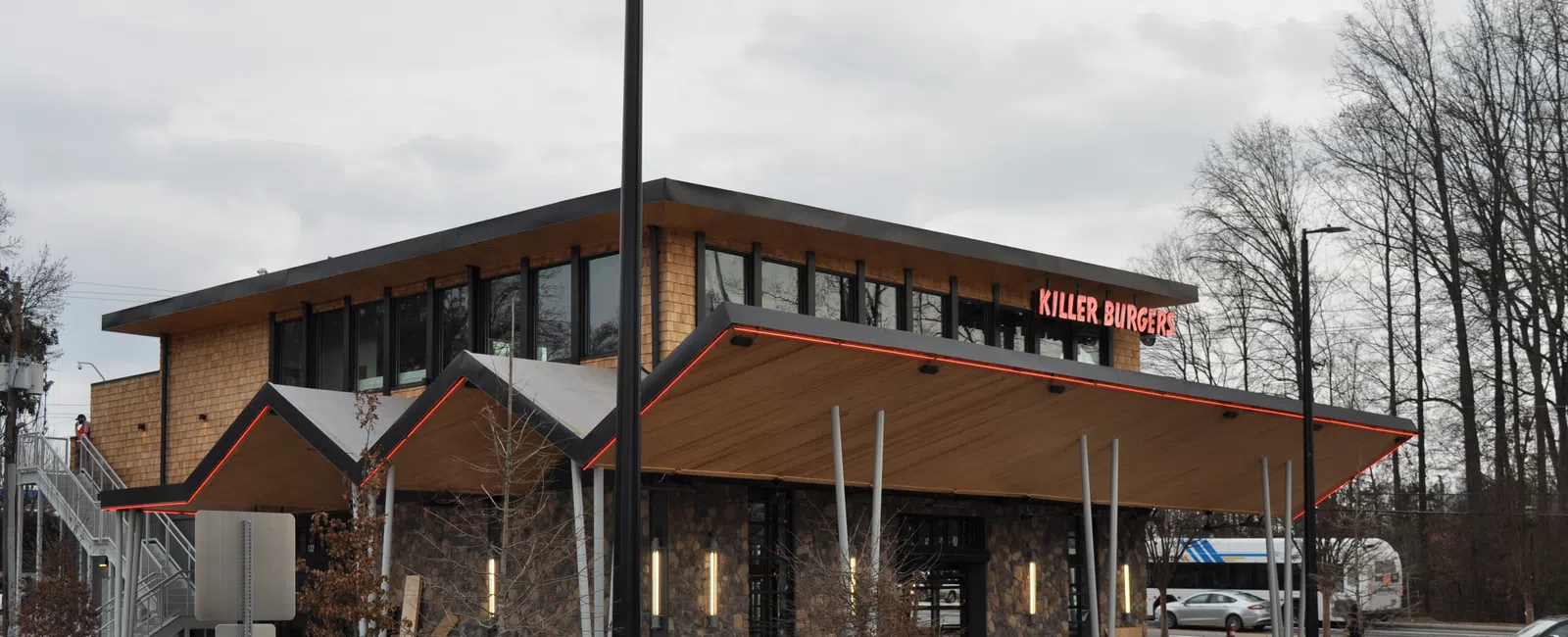
- Grindhouse Killer Burgers — full-service burger concept
- Damsel — restaurant and bar
- Brooklyn Bagel and Deli — deli and counter-service format
- Starbucks — café build-out
Plan your restaurant build-out with Dakota
Provide the details of your space and concept, and Dakota will define the full scope and a path to opening grounded in your specific project.